Know Your ExamTech
TL;DR
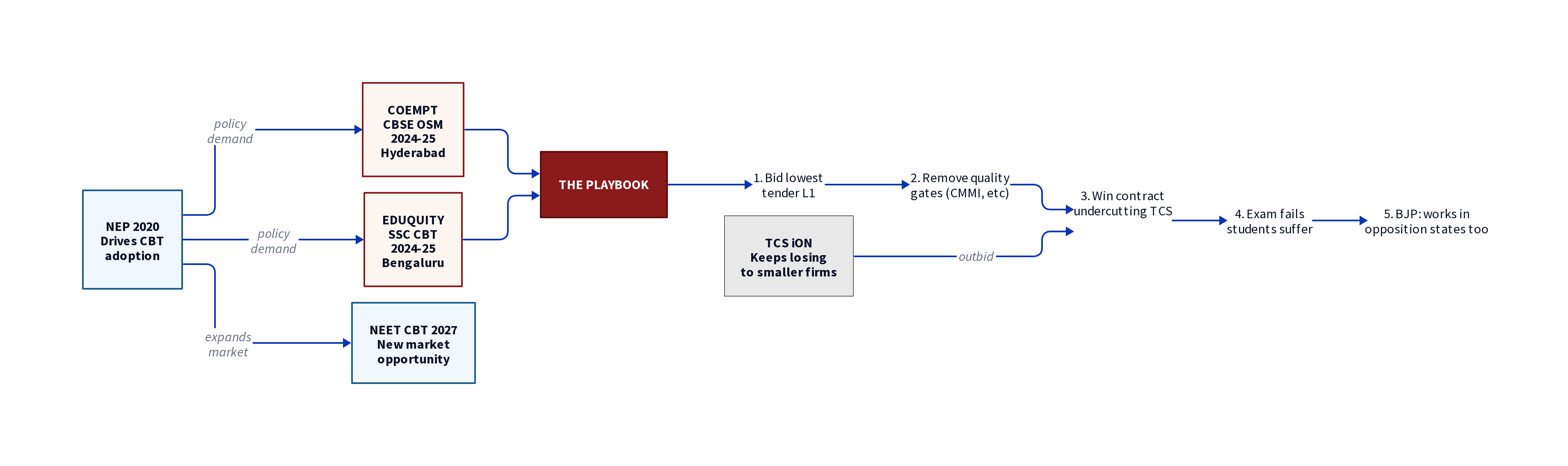
- Coempt (CBSE) and Eduquity (SSC) followed the same playbook: bid low after tender conditions were relaxed, win the contract, fail to deliver, get politically insulated.
- TCS loses because government tenders prioritize price over quality, specs get rewritten to exclude them, and they have bigger businesses to run.
- NEP 2020 and the NEET CBT transition (2027) are about to flood this broken market with even more demand — 30+ crore students dependent on the same opaque vendors.
- Nobody in power has an incentive to fix this. Your best weapon is documentation, RTIs, and public pressure.
1. The Market: Your Marks, Their Business
All of this needs technology: scanning, evaluation, mark processing, result compilation, CBT delivery, proctoring. The market is worth thousands of crores annually. And it's served by companies you've never heard of.
| Company | HQ | What They Do | Scale |
|---|---|---|---|
| TCS iON | Mumbai | CBT delivery, digital marking | ~₹1,000 Cr (est.) |
| Coempt EduTeck | Hyderabad | OSM, exam processing | ₹68 Cr (FY25) |
| Eduquity | Bengaluru | CBT delivery, assessments | ₹117 Cr (FY25) |
| MeritTrac | Bengaluru | Assessment & testing | ~₹100 Cr (est.) |
| Pearson VUE | Global | CBT (JEE, CAT) | Global |
| Prometric | Global | CBT delivery | Global |
Two of these — Coempt and Eduquity — have been at the centre of major scandals in the last 12 months. Both followed almost identical playbooks.
2. The SSC Scam: Déjà Vu
While you were dealing with the CBSE OSM mess, another scandal was unfolding at the Staff Selection Commission (SSC) — which conducts exams for government jobs millions prepare years for.
The Eduquity Story
In 2025, the SSC replaced TCS with Eduquity Career Technologies, a Bengaluru-based company that won by quoting lower. What happened next:
- July 2025: SSC Phase-13 exam — server crashes, biometric failures, students turned away. Chaos across India.
- Paper leak allegations: Repeated questions, alleged leaks in SSC GD 2026 exam.
- Massive protests. Students took to the streets demanding Eduquity be removed.
- YouTuber sued: Eduquity filed a ₹25 crore defamation case against YouTuber Nitish Rajput for exposing the scandal.
The Blacklist That Didn't Stick
Eduquity was blacklisted by the Directorate General of Training (DGT) in 2020 for exam-related irregularities. The DGT's own comparative statement lists Eduquity as "Ineligible."
Yet in 2025, Eduquity won the SSC contract anyway.
The Playbook
TCS qualified in CBSE OSM round 1 and round 2. TCS had been running SSC exams smoothly before replacement.
CBSE dropped CMMI Level 5 certification, scanning resolution requirements. SSC weighted QCBS to favour lower financial bids over technical capability.
Coempt bid ₹24.75/answer sheet. Eduquity bid ~₹273 crore for the CBT cycle.
CBSE: missing pages, blurred marks, score swaps. SSC: server crashes, biometric failures, cancelled exams.
"Coempt works in opposition states too." "Eduquity's role was limited, rumours."
The Comparison
| Parameter | CBSE / Coempt | SSC / Eduquity |
|---|---|---|
| Vendor HQ | Hyderabad | Bengaluru |
| Revenue | ₹68 Cr (FY25) | ₹117 Cr (FY25) |
| Previous scandal | 2019 Telangana Intermediate disaster | Blacklisted by DGT in 2020 |
| Tender manipulation | 3 rounds, conditions relaxed | QCBS weighted to lowest bid |
| The big loser | TCS | TCS |
| Mode of failure | Scanning errors, blur, swap | Server crashes, biometric failures |
| Political defence | "Works in opposition states" | "Role limited, rumours" |
| Student impact | 18.5 lakh students | ~50 lakh aspirants |
3. Why TCS Keeps Losing
India's largest IT company doesn't dominate government exam tech. Six reasons why:
Government tenders prioritize lowest price (L1). TCS, with ₹12 lakh+ crore market cap, cannot match cut-rate pricing of smaller firms. Coempt bid ₹24.75/answer sheet.
Requirements that TCS meets (CMMI Level 5, 300+ DPI scanning) get relaxed after initial rounds. CBSE dropped CMMI Level 5 in round 3. That's moving the goalposts.
Large companies have compliance teams that push back. Smaller firms work with looser arrangements. This isn't efficiency — it's the absence of accountability.
Exam tech is noise compared to $7.5B quarterly revenue. Thin margins, political scrutiny, limited upside. They've been quietly scaling back.
Indian tenders do NOT require: independent security audits, penetration testing, demonstrated uptime, track record of similar-scale exams, or vendor financial health checks.
Vendors build relationships across parties. Neither side wants to investigate too deeply because both have fingerprints on the same vendors.
4. NEP 2020: The Coming Flood
Here's where it gets personal. The National Education Policy (NEP) 2020 is about to dramatically expand the role of exam-tech companies in your life.
What NEP 2020 Mandates
Section 4.4 mandates "competency-based assessment" — moving from rote memorization to testing understanding. In practice:
- More digital assessments — competency-based testing is harder on paper
- More frequent evaluations — continuous assessment, not just one final exam
- PARAKH — new national assessment regulator setting standards for all 60+ school boards
- More data collection — every assessment generates data that needs processing
The NEET Timebomb
Who will build that CBT infrastructure? The same companies that botched CBSE OSM and SSC CBT.
NEET 2027 could be the next CBSE OSM — at an even larger scale.
5. The Reform Question
Immediate Fixes
Structural Reforms
What's Blocking Reform
- No political party wants to investigate too deeply — they all use the same vendors
- The bureaucracy benefits from opaque procurement
- Vendors face no consequences — they blame "rumours" and sue critics
- Students have no institutional power
6. What You Can Do
That the system permits this is the scandal. Your mangled marks are just the evidence.
Sources
CBSE OSM / Coempt
- India Today — CBSE OSM controversy
- India Today — CBSE relaxed tender norms
- Newslaundry — Behind CBSE's evaluation contract
- Shikshapedia — Coempt got contract 66 days before rollout
SSC / Eduquity
- India Today — SSC exam disruptions, chairman responds
- Financial Express — SSC chairman on Eduquity
- Inventiva — Eduquity, India's most controversial blacklisted company
- DGT Comparative Statement — Eduquity "Ineligible"
TCS
NEP 2020 / NEET CBT
- PARAKH NCERT — Official site
- Rediff — NEET-UG in computer mode from 2027
- Business Standard — NEET-UG CBT from 2027